
 Login
Login CN
CN

 2025.11.13.
Gene-edited mouse models are indispensable tools in modern biomedical research, driving breakthroughs in understanding disease pathogenesis and accelerating drug discovery. They allow researchers to precisely mimic human genetic conditions, providing a controlled and in vivo environment for study.
Model Generation: Precision Engineering
The creation of these sophisticated models relies on advanced genetic engineering techniques, traditionally utilizing Homologous Recombination (HR) in Embryonic Stem (ES) cells.
Key Steps in Mouse Model Generation (via HR):
● Target Selection: Identifying the specific gene (or non-coding region) to be modified, often based on human disease-associated mutations (e.g., a point mutation, a deletion, or an insertion).
● Targeting Vector Construction: Designing a DNA vector that contains the desired genetic modification (the "payload") flanked by sequences highly homologous to the target mouse genomic region. This vector also typically includes selectable marker cassettes (e.g., neomycin resistance).
● Electroporation into ES Cells: Introducing the targeting vector into mouse Embryonic Stem (ES) cells in culture. HR then occurs spontaneously, replacing the endogenous genomic sequence with the sequence from the targeting vector.
● Selection and Screening: Treating the ES cells with selection agents (like Neomycin) to isolate the rare cells where successful integration (the homologous recombination event) has occurred. The positive clones are then extensively screened by PCR and Southern blotting to confirm the precise edit and ensure no random integration occurred.
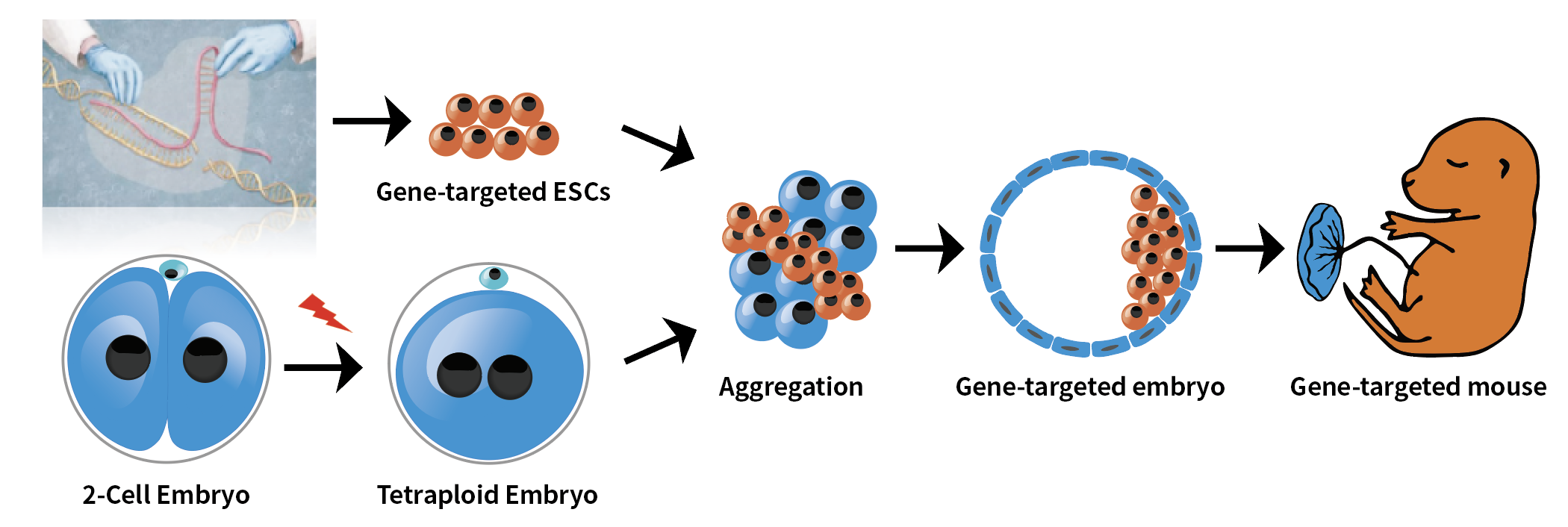
● Aggregate ES cells with tetraploid embryos:Micro surgically combine a single identified, correctly targeted diploid (2n) ES cell with a tetraploid (4n) embryo. Tetraploid embryos are created by electro fusing the two-cell stage embryos, and are developmentally restricted to forming extra-embryonic tissues (placenta).
● Form chimeric embryos:Allow the aggregation complex to develop in vitro (e.g., in a culture dish) for a short period, typically until the blastocyst stage (1-2 days). In this chimera, the tetraploid cells contribute only to the placenta, while the diploid ES cells give rise to the entire embryo proper.
● Implant chimeric embryos into pseudo pregnant surrogate mice:Surgically transfer the developed chimeric blastocysts into the uterus of a recipient female mouse which has been hormonally synchronized to be in a receptive pseudo pregnant state (mated with a vasectomized male).
● Tetraploid mice production:Transfer the complemented embryos into surrogate mice to obtain mouse models entirely derived from ES cells.Perform genotyping confirmation to ensure the correct genotype, thereby obtaining a stably inherited mouse model.
● PCR Genotyping Service:Targeted PCR amplification and analysis of tail biopsy DNA.
● Weaning:Mice were weaned at 21 days post-partum (dpp) and subsequently transported under controlled conditions.
Application Scenarios: Unlocking Therapeutic Potential
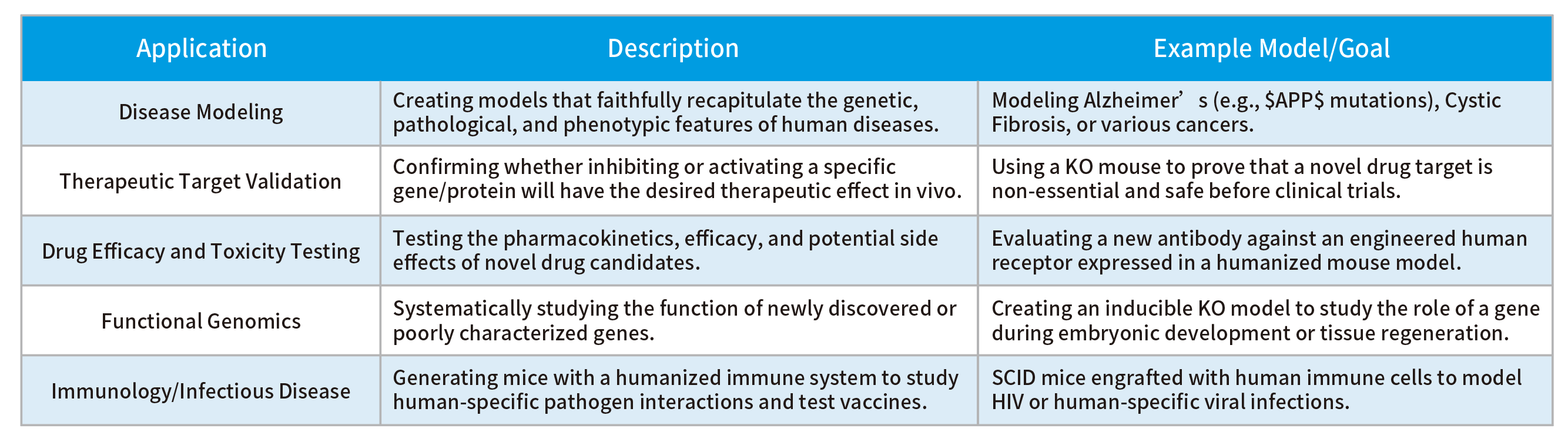
Gene-edited mice are the gold standard for preclinical research, offering invaluable insights across multiple domains:
Special Statement: This article is sourced from the official website of MingCeler Biotech. Personal sharing is permitted. However, media outlets or organizations are strictly prohibited from reprinting or republishing this content on any other platform without prior authorization. For reprint authorization or other cooperation inquiries, please contact: sales@mingceler.com.
Disclaimer: Some materials used are sourced from the internet. If any infringement occurs, please contact us for removal. This article is intended for informational purposes only and does not constitute medical advice or provide treatment recommendations. The views expressed herein do not represent the official stance of MingCeler Biotech, nor do they imply Mingceler Biotech's endorsement or opposition to the opinions presented.

